Play store



For thousands of Bangladeshi workers hoping to build a better future abroad, securing a job in Malaysia can come at an extraordinary price. Although employers need workers with the right skills and experience, allegations of excessive recruitment fees, opaque procedures and the influence of intermediaries have raised a troubling question: has the ability to pay become more important than the ability to do the job?
Malaysia remains one of Southeast Asia’s major destinations for foreign workers, employing Bangladeshis in construction, manufacturing, agriculture, services and plantations. Bangladeshi workers have established a significant presence in the country, contributing to its economy through their labour and skills. Yet repeated suspensions of recruitment, allegations of syndicate control and high migration costs have undermined confidence in the process.
As Bangladesh seeks to expand access to the Malaysian labour market, the challenge is no longer simply to send more workers abroad. It is to ensure that recruitment is transparent, affordable and based on employers’ actual requirements.
The stakes are high. Excessive migration costs can push workers into debt before they begin earning, while irregular recruitment practices risk damaging Malaysia’s confidence in Bangladesh as a reliable source of labour.
The Tk40,000 Question
The cost of securing employment in Malaysia has become one of the most contentious issues in Bangladesh’s overseas recruitment system.
Under commonly cited estimates, expenses for a passport, membership of the Wage Earners’ Welfare Board and recruitment-related formalities could total around Tk40,000 to Tk45,000. Yet many Bangladeshi workers have reportedly paid Tk400,000 to Tk500,000 to travel to Malaysia. In some cases, the amount has allegedly reached Tk700,000 to Tk800,000.
The gap raises fundamental questions. If a worker needs to spend such a large sum to obtain a job, where does the money go? Why is there no clear breakdown of the charges? And why do the amounts reportedly paid by workers differ so sharply from prescribed migration costs?
The precise cost varies according to the applicable rules and the expenses involved, but workers should not be left to navigate an opaque system in which charges are unclear and accountability is difficult to establish.
For many migrants, the financial consequences are severe. They borrow from relatives, sell land or other assets, or take high-interest loans to finance their journey. Once in Malaysia, a substantial portion of their earnings may have to go towards repayment.
This leaves workers financially vulnerable from the outset and can make them less able to challenge unpaid wages, poor working conditions or other forms of exploitation.
A Market Repeatedly Disrupted
Bangladesh’s recruitment relationship with Malaysia has been marked by repeated openings and suspensions.
Recruitment was suspended in 2008 and resumed in 2016 before being halted again in 2018. Following a memorandum of understanding signed by the two countries in December 2021, worker deployment resumed in August 2022. The process was suspended again from June 1, 2024.
Each disruption has been accompanied by concerns about recruitment irregularities, excessive charges, syndicate influence and weaknesses in the management of overseas employment.
Despite repeated initiatives, the underlying problems remain unresolved. The uncertainty affects workers waiting to leave Bangladesh, recruiting agencies seeking to operate lawfully and Malaysian employers who need a reliable supply of labour.
The issue also has implications beyond bilateral relations. Malaysia is deeply integrated into global supply chains, and allegations of forced labour, human trafficking and worker exploitation can damage its international reputation. Labour-rights concerns have previously led to restrictions on some Malaysian products in overseas markets.

Excessive recruitment fees imposed on Bangladeshi workers have also complicated relations between the two countries. Malaysian authorities and stakeholders have reportedly argued that irregularities originating within Bangladesh’s recruitment system must be addressed by Bangladesh itself.
That position places a clear responsibility on Dhaka. Without credible reform, repeated requests to reopen the market may not be enough to restore confidence.
Government Action and the Transparency Gap
The government has reportedly held consultations with recruiting agencies, non-governmental organisations, the International Organization for Migration and the International Labour Organization to address excessive migration costs and recruitment irregularities.
Recruiting agencies have cited expenses associated with securing job orders and visas, maintaining overseas representative offices and meeting other recruitment-related costs. According to accounts of these discussions, such expenses may range from Tk100,000 to Tk300,000 per worker, depending on the destination and circumstances.
However, the existence of recruitment expenses does not, by itself, justify charging workers any amount an agency chooses. The critical issue is which costs employers are expected to bear, which charges are legally permissible and whether all payments are properly documented.
The ILO has been cited in stakeholder discussions in connection with a benchmark equivalent to two months’ wages for recruitment costs. Such benchmarks must be understood in context and should not be interpreted as automatic permission to transfer recruitment expenses to workers.
A ministry investigation into Bangladeshi workers who failed to travel to Malaysia in 2024 reportedly found that many had paid several times more than the government-prescribed amount of approximately Tk79,000. Some were said to have paid Tk600,000 to Tk700,000.
There have also been allegations of irregularities involving workers recruited for Serbia. The Minister for Expatriates’ Welfare and Overseas Employment reportedly questioned agencies that had allegedly collected substantial sums without obtaining the necessary government approval, leaving workers waiting with their money and passports in the agencies’ hands.
Separately, reports indicate that the licences of 49 recruiting agencies were revoked over alleged excessive charges and irregularities associated with Malaysia-bound recruitment. Cases involving alleged money laundering have also been reported as pending before the courts.
These measures indicate the scale of concern, but enforcement must go beyond cancelling licences or initiating cases. Workers need effective mechanisms to recover money, obtain their documents and seek justice when recruitment promises are not honoured.
Without visible results, the same practices may continue under different intermediaries.
Who Gets Selected for a Job?
The recruitment system is also facing questions about how workers are selected.
A transparent process should match candidates with employers’ actual requirements, taking account of skills, qualifications, experience and medical fitness where relevant. A properly maintained government database of eligible candidates could help make that process more accountable.
Yet stakeholders say the absence of an effective, functioning database has made transparent selection difficult.
“We know that workers are supposed to be recruited from the government database first. But there is nothing there. We are forced to select workers through advertisements,” an owner of a recruiting agency told this correspondent on condition of anonymity.
The agency owner alleged that some recruitment takes place outside both the database and open advertising procedures, with opportunities sometimes going to those able to pay more. He also alleged that forged documents are used in some cases.
These claims require verification, but they point to a wider institutional weakness. If candidates are not selected through clear procedures, it becomes difficult to establish whether recruitment decisions reflect merit or financial influence.

The government must ensure accountability throughout the process, from verifying an employer’s demand for workers to selecting candidates, determining permissible charges and confirming that the promised jobs actually exist.
Money Versus Skills
The consequences extend beyond individual workers.
Research by the Refugee and Migratory Movements Research Unit (RMMRU), an organisation working on migration issues, has highlighted the damaging effects of excessive migration costs, according to information cited by stakeholders.
There are also allegations that some recruiting agencies, seeking higher profits, send candidates who do not meet employers’ requirements. In some cases, documents falsely claiming that workers possess particular skills or qualifications have allegedly been used.
If substantiated, such practices could undermine employers’ confidence in Bangladeshi workers and weaken the country’s reputation as a reliable labour-sending nation.
Bangladesh cannot build a sustainable overseas employment strategy simply by increasing the number of people sent abroad. It must also ensure that workers are properly trained, their qualifications are verified and their skills match the jobs available.
Research by OKUP, an organisation working on migrant workers’ rights, has also highlighted Bangladesh’s dependence on a limited number of overseas labour markets, according to stakeholders. Diversifying destinations and investing in skills development are therefore essential.
Stakeholders have also cited findings from surveys by the Bangladesh Bureau of Statistics indicating that overseas employment can involve migration expenses amounting to several hundred thousand taka. Meanwhile, research by the Centre for Policy Dialogue has reportedly documented cases in which people trained at government technical training centres still failed to secure overseas employment.
These concerns expose a serious disconnect between training and employment.
If workers complete vocational courses but cannot find jobs abroad, the government must examine whether training programmes are aligned with actual labour-market demand. Technical training centres should work more closely with overseas employers, recruitment agencies and industry bodies to identify the skills required and improve job placement.
Training should lead to credible employment opportunities, not merely certificates.
Indonesia Emerges as a Competitor
Bangladesh also faces growing competition from other labour-sending countries.
As of June 2025, more than 803,000 Bangladeshi workers were registered in Malaysia, compared with approximately 543,000 Indonesian workers. These figures underline Bangladesh’s established presence in the Malaysian labour market.
However, the competitive landscape is changing.
Indonesian worker recruitment to Malaysia reportedly fell by 28.4 per cent in 2024, from 72,257 to 51,723. Despite that decline, reports suggest that some Malaysian employers are exploring alternative sources of labour because of delays, policy uncertainty and a lack of transparency in recruiting workers from Bangladesh.
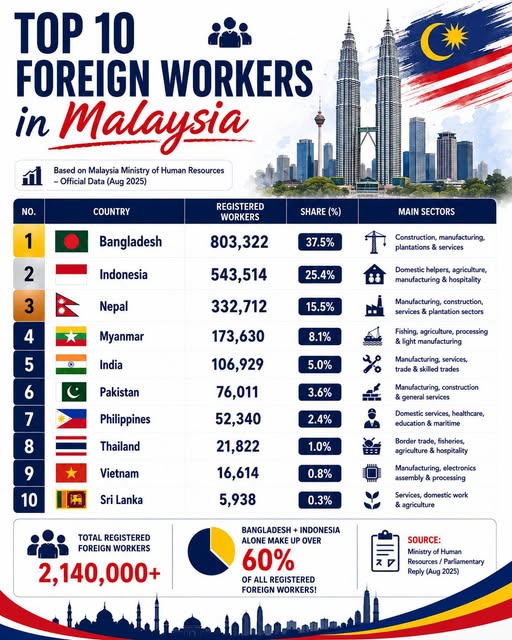
A report by Malaysian media outlet Malayakhabar said several multinational companies and major employers were considering alternative recruitment channels. It also reported interest in recruiting Indonesian workers through arrangements in which employers cover the full recruitment costs, including visas and air tickets.
According to the report, the recruitment process from Indonesia was considered comparatively faster and more transparent.
These reported preferences should not be taken as proof that Indonesia will replace Bangladesh. Recruitment trends depend on labour demand, government policy, costs, worker availability and the reliability of supply.
Nevertheless, the warning is clear. Bangladesh’s large pool of workers will not guarantee its market position if employers encounter persistent delays, unpredictable costs and allegations of irregularities.
In a competitive labour market, reliability matters as much as numbers.
Why Employers Also Have a Stake
Transparent recruitment is not only a matter of protecting Bangladeshi workers. It is also in the interests of Malaysian employers.
A Malaysian human rights activist, speaking on condition of anonymity, said some companies had faced difficulties because Bangladeshi workers arrived after incurring excessive recruitment costs. The activist claimed that international pressure had compelled several companies to refund additional fees collected from workers.
The activist urged Malaysian employers to consider recruiting qualified candidates through Bangladesh’s government database, arguing that a transparent process could reduce opportunities for excessive charges and improve worker protection.
The proposal deserves serious consideration. Employer-led recruitment, with clearly defined responsibilities and properly documented costs, could help reduce the role of intermediaries who profit from workers’ desperation.
Both governments have a role to play. Bangladesh must regulate its recruitment agencies and protect workers from exploitative charges. Malaysia must ensure that employers comply with labour laws, recruitment requirements and their obligations towards migrant workers.
Cooperation between the two countries could also improve verification of job orders, prevent fraudulent recruitment and establish channels for resolving disputes.
The Way Forward
Bangladesh needs a comprehensive reform of its overseas recruitment system if it is to preserve and expand access to Malaysia’s labour market.
First, the government should publish a clear and accessible schedule of permissible migration costs, specifying the expenses under each category and identifying which charges must be borne by employers. Workers should receive itemised receipts for every payment, while recruitment agencies should be required to maintain verifiable records.
Second, the government must establish and operationalise a reliable database of eligible workers. Recruitment should be based on verified employer demand, relevant qualifications and transparent selection criteria. Open advertising and traceable procedures should be mandatory wherever applicable.
Third, the authorities must strengthen enforcement against proven violations. Investigations into excessive fees, forged documents, fraudulent job offers and alleged syndicate control should be conducted transparently. Workers must have practical ways to report abuses, recover money and reclaim passports and other documents.
Fourth, vocational training must be linked more closely to the requirements of overseas employers. Bangladesh should invest in technical skills, language proficiency, workplace safety and certification that employers can readily verify.
Fifth, the government should diversify overseas employment destinations rather than depend excessively on Malaysia or a limited group of Middle Eastern markets. Diversification would give workers more choices and reduce the impact of recruitment suspensions in any single country.
The government has reportedly requested Malaysia to facilitate the deployment of 10,000 Bangladeshi workers at zero migration cost. If implemented with transparent selection and effective safeguards, the initiative could establish a useful precedent.
But a zero-cost arrangement for 10,000 workers would not, on its own, solve the wider problem. The objective must be to build a recruitment system in which excessive fees cannot determine who gets a job and where workers are not forced into debt to access employment.
The government should also pursue credible investigations into alleged irregularities under previous administrations and take action against those found responsible through due process. Accountability must apply equally to agencies, intermediaries and any officials or other actors implicated in wrongdoing.
A Question of National Credibility
Malaysia remains an important destination for Bangladeshi workers, but its labour market cannot be treated as guaranteed access. Employers have choices, competing countries are seeking opportunities, and recruitment policies can change.
Bangladesh’s strongest advantage should be its ability to supply workers who are skilled, reliable, fairly recruited and properly prepared for employment.
That requires a fundamental shift in priorities. The success of overseas employment should not be measured only by the number of workers sent abroad or the amount of remittances they generate. It should also be measured by the cost of migration, the quality of employment, workers’ protection and the income they can retain after meeting their living expenses and repaying any legitimate debts.
The central question remains: should a worker’s ability to pay hundreds of thousands of taka determine access to a job in Malaysia, or should the decisive factors be skills, qualifications and experience?
For Bangladesh, the answer must be clear.
A transparent, merit-based recruitment system would protect workers, strengthen bilateral relations and help preserve the country’s competitiveness in the international labour market. Without such reform, excessive costs and recruitment irregularities will continue to burden migrants and could gradually erode Bangladesh’s position in Malaysia.
The country does not merely need to send more workers abroad. It needs to ensure that qualified workers can secure jobs without being forced to pay an unjustifiable price for the opportunity.