Play store

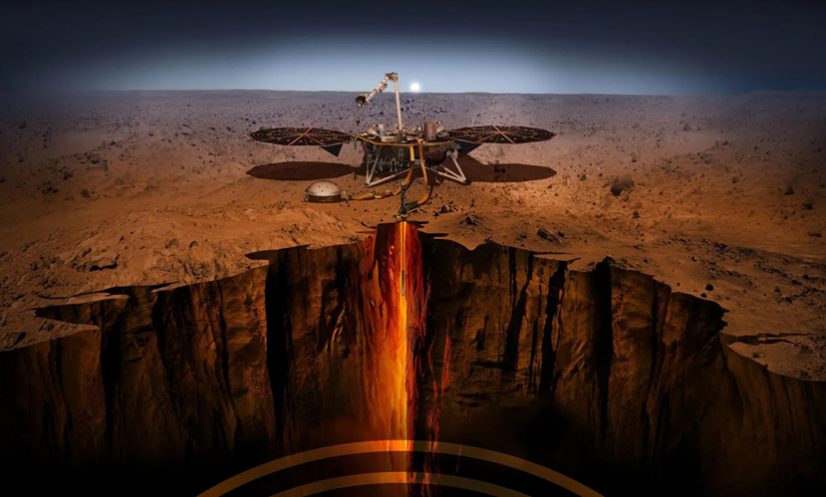
Researchers at the University of Oxford have found evidence that Mars may once have contained enormous, Earth-like magmatic systems deep beneath its surface, despite lacking the plate tectonics that shape Earth’s geology.
The findings, published in Nature Astronomy, challenge the long-held view that Mars developed its crust through relatively simple geological processes and suggest that rocky planets may evolve complex interiors without Earth-style plate tectonics.
Mars is generally classified as a “stagnant lid” planet because its outer shell is not divided into moving tectonic plates. On Earth, plate tectonics drives volcanism, recycles crustal material and contributes to the formation of continents.
However, the new study suggests Mars may have produced highly evolved crust through extensive internal recycling.
The researchers analyzed seismic data from NASA’s InSight mission, including waves generated by marsquakes and meteoroid impacts. They focused on a previously identified boundary about 24 kilometres beneath the Martian surface whose geological origin had remained uncertain.
Scientists from Oxford’s Departments of Earth Sciences and Statistics compared the seismic observations with hundreds of possible rock compositions. Using thermodynamic modelling and statistical analysis, they identified the materials that best matched the seismic properties detected at different depths.
The results indicate that rocks below the 24-kilometre boundary are most consistent with ultramafic material, which is rich in iron and magnesium and relatively low in silica. Rocks above the boundary appear more consistent with mafic compositions, which contain higher levels of silica.
The researchers believe the buried layer may have formed when molten rock accumulated deep underground and gradually separated into different materials. Dense crystals would have settled toward the bottom, while lighter, chemically evolved melts moved upward.
The findings indicate that Mars may have experienced extensive magmatic recycling and crustal differentiation, producing geological complexity previously thought to require plate tectonics.
The study could also broaden scientists’ understanding of how rocky planets develop and how geological processes may influence their potential to support habitable environments.