


 Play store

The United Nations has renewed its call for urgent global action to regulate artificial intelligence (AI) in warfare, warning that increasingly autonomous weapons are making modern conflicts deadlier and posing serious risks to civilians.
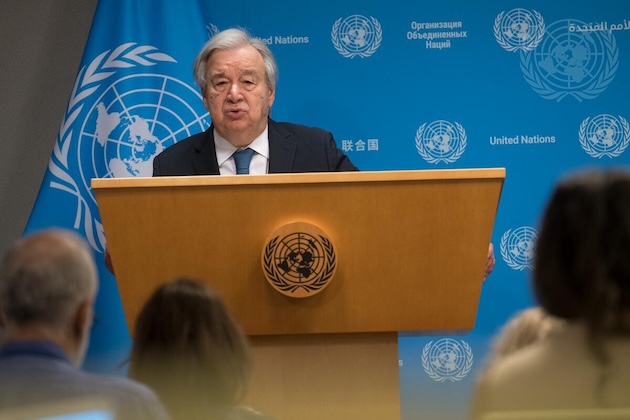
UN Secretary-General António Guterres recently cautioned that rapid advances in AI are accelerating the development of sophisticated autonomous weapons, including drones capable of inflicting massive harm with limited human involvement.
“The technology is heightening the danger,” Guterres said, warning that some decisions, especially those involving the taking of human life, “must remain forever human.”
The warning comes as drones and AI-assisted weapons are playing an increasingly significant role in conflicts involving the United States, Iran, Israel, Russia and several civil wars across Africa and Asia.
Human rights experts say fully autonomous weapons capable of selecting and attacking targets without meaningful human control would represent a dangerous shift in modern warfare.
Simon Adams, Professor of Human Rights at Australia’s Murdoch University and former President of the Center for Victims of Torture, said no country has publicly acknowledged deploying completely autonomous lethal weapons. However, he warned that many major military powers are increasingly relying on drones, robots and AI systems, with algorithms already helping identify bombing targets in conflict zones.
“AI has enormous potential to improve lives, but it would be a global tragedy if it were used to create new ways of outsourcing war to machines,” Adams said.
He described autonomous “killer robots” as ethically indefensible and called for an international treaty banning such weapons before they become widespread.
Peace campaigners also support legally binding restrictions. David Swanson, campaign coordinator for RootsAction, said dozens of governments have already expressed support for prohibiting autonomous weapons, suggesting that a treaty similar to the Treaty on the Prohibition of Nuclear Weapons could be negotiated.
Nick Mottern, co-coordinator of the Weaponized Drone Ban Treaty Campaign, argued that banning only fully autonomous weapons would not go far enough.
Instead, he called for prohibiting all armed drones, warning that militaries are likely to claim humans remain “in control” even when AI performs most of the targeting and attack decisions.
Meanwhile, defence spending on AI-powered military technology continues to grow rapidly. According to The New York Times, the United States plans to allocate about US$55 billion of its proposed defence budget next year to develop AI-enabled unmanned weapons systems, reflecting a broader shift towards cheaper and more technologically advanced military capabilities.
Despite growing military applications, the UN emphasised that AI also offers significant humanitarian benefits, including healthcare, disaster response and disease control, provided its development is guided by effective international rules and safeguards. Source: IPS